Category Archives: Books

If You’d Asked Me… Great God, Good Beer, Crazy People **FREE READ**

This book is work in progress. You can buy a copy, right now, in PDF format, or, if you like, as a paperback. For details, visit our home page or send a request through our Contact form.

To follow the progress online, click on the little orange icon beside the P&S Press feed, over there in the right-hand sidebar. ⇒ ⇒ ⇒

If You’d Asked Me, I’d Have Told You…

Introduction

What on earth is this?

So I’m sitting at the mechanic’s garage, waiting for his guys to change the Dog Chariot’s oil, check all its various hoses, connections and whatnots, and generally cooling my heels. I’ve brought some work to do, but somehow my mind resists focusing on the job of turning Chinese-tinted math treatises into publishable English. The computer snoozing at my side, I turn to a stack of small books lurking on the vintage Goodwill coffee table with which Chuck has decorated his waiting room.

They are, it develops, light and entertaining collections of a single author’s bons mots: some of them funny, some sentimental, some touching, some more or less inspirational.

Saleable, think I as I study the things. Highly saleable. And then the light dawns in the dim recesses of the writerly mind: I already have a bunch of squibs like these! I happen to write for a social media site called Quora. There, members from all over the world pose questions – some in earnest, some silly, some apparently the products of drugged or fevered minds – and other members entertain themselves by answering them.

Herewith, then, If You’d Asked Me… Sassy, staid, off-the-wall, matronly, bitchy, conservative, liberal: with you I share the wisdom of the ages. The ages of a very long life. Enjoy!

—Victoria Hay
Phoenix, Arizona

Section I
God Is Great, Beer Is Good, and People Are Crazy

1. What’s the weirdest thing a guest has done at your house?

Painting the cat?

When I was finishing the doctorate, I got a grant that covered about three months of research time in England. My husband decided he would take a sabbatical from his firm and come with me.

We had a beautiful home in a historic district, and we had a couple of cats. So we needed someone to house-sit while we were gone for such a long period. The office manager at my husband’s law firm volunteered to do this. He had house-sat for other people and was known to be reliable and trustworthy.

So off we go, and this gent is left to take care of the manse.

A few weeks later, we hear from one of the partners: The guy had gotten drunk and, en route to a restaurant about 20 miles out in the desert, had missed a curve, flown off the road at a high rate of speed, and killed not only himself but two women who were in the car with him.

One of the partners had a couple of cousins, two young women, who were in town for some damnfool reason—why, I do not remember. He suggested we put the girls up in our house, so someone would be there to feed the cats and fend off the burglars. So we agreed to this.

Fortunately, my father (who had been around the block a few times) was in the offing and decided to keep an eye on the pair.

When we got back, he was supposed to pick us up. Instead, his wife showed up at the airport. She said he was staying at the house because they had decided the two girls were going to rip us off: they believed their boyfriend was planning to come back and burglarize the house the minute the girls left. So my father was staying there to guard the place. He urged me not to leave the house until the locks could be changed.

Well: boyfriend didn’t show up while my father was there. I thought my father had gone off the deep end.

Not so much. . . .

Boyfriend did surface several hours later. When he appeared at the door (he rang before sticking the key in the deadbolt), I told him to take a flying f*** at the moon, and (amazingly), he crawled back under his refrigerator. We changed the locks.

Now we learned that the girls had found the car keys, taken my husband’s Mercedes for a spin, and dented it. They had stolen checks, forged one for a hundred bucks (this was the 1970s, when a hundred bucks was a fair amount of money), and tried to cash it. Fortunately, in those days our city was still fairly small, and the bank manager knew my husband well enough to suspect a scam, and so the bank refused to fork over the cash. Because they’d made off with a whole book of checks, we had to close our bank account and open a new one with a new account number.

We had arranged to have the house painted while we were gone (thinking the house sitter would be at the office most of the time). The cat was coated in paint.

They had taken it upon themselves to use my largest, most wildly expensive Le Creuset Dutch oven to make popcorn, which they burned so solidly to the bottom of the pan that it could not be salvaged—I had to throw it out.

They stole a suitcase, which they presumably used to pack some of the other stuff they stole.

We had other wacky experiences with other house-sitters—like the one who was sitting when a sickly cat (different cat) finally died. The young woman was all upset. She was SO distraught that her boyfriend, who happened to be a relative of our vet, put our vet up to performing an autopsy on the dead cat!!

When we got back, the vet presented us with a bill for some brain-banging amount of money for having cut up the cat, discovered that yes, the cat died of the congenital disease we knew was someday going to carry it off, and assured the lady that the cat’s demise was not her fault.

2. How can I seem less arrogant to people who are less intelligent?

In my experience, the sure-fire strategy is to get them to talk about themselves and then listenwith sincere interest to what they say. Do not tell them what you think; ask them what they think. Do not tell them about your extraordinary life; ask them what they do. Ask them leading questions to bring out more conversation about themselves: “What did you major in at Podunk State? What was your favorite team in college (or high school, or whatever)? What did you like best in that last Star Wars movie?”

And for hevvensake, NEVER ask them what they think of Donald Trump!

Make this approach a habit, and they’ll think you’re the soul of humility.

Hard to be humble…

3. What is the most badass comeback you’ve ever heard?

For many years I dated a man who prided himself at being . . . shall we say, an artist at frugality (not to say “a cheapskate”). Among his many frugal tastes was the type of wine that might best be called “plonk.” In his mind, the cheaper the wine, the finer the vintage.

One day I had a BYOB party, to which everybody and his/her little brother were invited. My best friend showed up—after having passed through a lengthy hippy period, she had matured into quite an elegant woman, with a good job that paid a very good salary. She had grown up in central California, and though her family was not wealthy she did know about mid-range California wines.

She and her boyfriend had brought a bottle of wine, which they soon consumed.

Seeing their predicament, my boyfriend gallantly offered her some of his. To my amazement, she accepted. She took one sip of it and then gazed up at him with her wide, spectacular brown eyes.

“Did someone sell this to you as wine?” she asked.

4. Who personally loses when you rob a bank?

You. You end up in jail, making you The Biggest Loser.

Welcome home!

5. I volunteer at a hospital, but none of the doctors have any high-end cars. Why?

When she’s not in the operating room…

It’s my understanding that doctors don’t earn as much as they used to, relative to the rest of the proles. In addition, many graduate from medical school up to their noses in debt.

One friend, a man who went on to medical school after having become a PA and realizing medicine was truly his calling, told my son that between the educational loans and the cost of a house for himself, his wife, and their two children, he is now $1 million in debt. That doesn’t leave a lot of room in the budget for payments on a Mercedes.

Also, some doctors have their priorities straight. In this gentleman’s case, it’s clear he understands that some things are more important than a gaudy car.

A new route to self-publishing? An inchoate idea

Okay, so we know that self-publishing on Amazon and waypoints is no big money-maker, at least not for most folks. We also know that some of us “publish” our squibs not because we want to get rich or become famous writers, but because we’d like to share our creative extrusions with the few people in the world who might care to read them. In thinking about this state of affairs, an inchoate idea comes to mind..

If you’re going to publish for free, why pretend that you’re publishing for a profit? Why not just…yes…publish for free?

Self-publishing begins to make sense when you think of it not as a potential money-maker but simply as a way to get stuff that is written for the fun of writing to people who read for the fun of reading. 

In a word, it’s not a business; it is a hobby.

With that thought in mind — particularly where a novel-in-progress is concerned — how would this work? How would you get your scribblings to the greatest number of interested readers at the least cost?

Here’s a strategy that comes to mind. I would love to know what readers think of this scheme and what you would add, subtract, multiply, or divide.

§

• First, write the magnum opus. You could either write and polish the entire novel, or you could write a few chapters and publish them serially as you go, much as, say, Charles Dickens wrote his novels. Serial publication was popular in the 19th century and even all the way through the middle of the 20th century. I can remember following stories in The Saturday Evening Post…and for heaven’s sake, the digital publishing universe invites serialization. It’s surprising that we don’t see serialization again. Not in the sense of a series of genre novels, but as publication of a single work in regularly appearing segments.

Post teasers on Facebook. These would be scenes or descriptive passages or bits of dialogue that leave the reader wanting (you hope!) to read more. Link from there to your website, where an entire serial might be posted.

• Post teasers at Amazon, for free, inviting people to come to the website for more. Here is how you would do this:

Take one or more of your serials (enough to make some sense and to intrigue the reader), put them together into one manuscript, and format the thing as a short e-book. This might be, say, 5,000 to 10,000 words. Make it clear in there that this is part of a larger work, and if they want to read the rest of the story, they should come to your website where they can follow it, for free, or download a free copy of the whole noveloid.

Publish this squib — with the plug for other parts of it included in the bookoid — through Amazon’s KDB program and set the price as $0.00. That is, publish it for free. Doing so will cause a few readers at Amazon to notice and read the book, and they will notice that you are publishing more serials at your website: free.

Back at your website, serialize the story, for free, in the form of blog posts. (A good WordPress template will allow you to create website a with a static front page, pages to advertise your products, and a blog — that is what you are reading now, at this P&S Press site.

You don’t have to buy a domain name if you make the blog name a subdomain. So this would allow you to have a single website, in your name or in your business’s name, with a series of subdomains bearing your separate novels’ names. This is very easy.

When you finally complete a seralized book, offer it — in digital format only — for sale at Amazon and/or on the site. You can do this easily, for free, if the book does not have a lot of graphic content. Any novel will upload handsomely to Amazon’s Kindle format.

This is the only part of the process that should cost you anything: you might want to have it copyedited or at least proofread. If you’re an accomplished, literate writer with experience in publishing, you may find that unnecessary, though most people are helped by another set of eyes to read the copy.

If you want to ask money for it, when it goes on Amazon, offer it for what you’re charging at the website…or maybe even more. At your Website, you can offer it in ePub format, which can be read on practically any device, or in PDF. Either of these formats can be prepared for free. You can make an ePub book in Scrivener, and any Mac or PC will make a very fine PDF, which you can “lock” to keep it from being copied.

But if you felt you just must make some money on it, once you built a decent readership, you could sell advertising within the book, in the same way magazines, newspapers, and websites sell ad space. Indeed, nineteenth-century fictional works did carry advertising. Writing a genre novel? Suggest to other scribblers in your genre that they buy ad space in your book or on your website. Doesn’t cost you anything, so even a few pennies is pure profit for you.

Electronic publishing is essentially free. The only part of the process of bringing finished copy to the reader that should cost you any money is preparing printed, hard-copy books. Otherwise, plain-vanilla text without a lot of jpegs, tables, and graphs is so simple to convert to digital format you need not pay anyone to do it for you.

So. Publishing is free. What that means is that if you don’t care whether you make any money on your golden words — if you write and distribute your content as a kind of hobby — there is  no reason at all to pay to have it published. No reason to produce it as a bound book in hard copy. No reason to distribute it in any other way than as a freebie give-away.

Why not?

Hassle Central, reporting in…

It’s been awhile since I posted here, more out of laziness and general harassment than intent. “Upgrading” both my Macs to OS X El Capitan was a big mistake. It’s a buggy program and has almost disabled the little MacBook Pro — the machine I use most of the time because sitting at a desk makes the aged back hurt. A lot.

So bad is it that I’m seriously considering buying a PC to replace the laptop. Big step backward for me: I really, really don’t want to relearn Windows (ugh!), nor do I want to have to “upgrade” to Office 365 so as to work on a Windows machine.

Actually, though, getting a lightweight Windows laptop to use only for Word and Excel tasks would probably make sense. You can still buy a standalone copy of Office 2016, and it will run fairly trouble-free on Windows.

Not so much on a Mac. The reason I did not update to the latest operating system, Sierra (don’t those cutesy names aggravate you?), is that my version of Word will not run at all on Sierra. Neither will Office 2016, at least not without endless bugs.

And the reason I do not want to sign up for Office 365? How can I count the reasons?

Foremost are these three:

1. It’s a rip-off. Renting the damn program with a monthly payment will quickly cause the cost to add up — and up, and up, and up — to way more than the cost of a program resident in your own computer. I resent that more than I can say.

2. Much of the work I do is proprietary. I do not want to be working on my clients’ projects in the flickin’ CLOUD! Indeed, sometimes I have to sign an agreement that I will not allow anyone else to see the client’s research or to put it at risk of being seen by anyone else. Sticking some scientist’s paper on a Microsoft server could put me at risk of liability. Even if I wanted to do that. Which I don’t.

3. Functionality of documents created or edited in non-365 versions may be limited. So it’s questionable whether I’d even be able to work on a document using more than one of my computers, even if one were a Windows machine.

Truly, this is a mess. I don’t know which way to jump and am truly furious that Apple has turned my computers from “it just works” to “it just doesn’t work.”

Meanwhile, in saner realms:

Delivered a presentation yesterday:Structure of Feature Articles.”

People in the audience wanted to buy the new book, The Complete Writer. It’s still in page proofs — I need to cut the back cover copy some and adjust the design accordingly, and need to check the second proofs AGAIN. But by the next meeting, I hope to have a carton of hard-copy paperbacks to tote out to the group.

Incoming paid work has…come in. Read about 17,000 words of academicese compiled by a pair of ESL co-authors.

These people hold me in awe. They’re required to publish in English-language journals. And they do it — with panache.

Can you imagine an American academic writing a dissertation or a scholarly paper in Chinese? Fat chance! It’s all we can manage just to stumble through a PhD program in English…and many US universities have quit requiring a second and third language for the PhD.

I could probably write a journal article in French and have it come out about on a par with what the Chinese authors produce in English. But folks…as an undergraduate I majored in French! Not in math, not in economics, not in communications, not in political science…. Criminey!

And as for the novel: ça va, lentement.

Weirdly, drafting scenes in ink with a real pen is one of the things that’s making me resent the computer hassles as passionately as I have come to do.

A pen and a piece of paper do not go offline. They do not crash and shut down everything you’re working on

Well, OK: the pen can run out of ink. But when it does, you do not lose any of the words you’ve just written. The two other documents you’re working on do not disappear into the ether. The spreadsheet you’ve been wrestling with does not lose an hours’ or a day’s worth of data.

You can carry a pen and a notebook around, and it will work anywhere you choose. You do not have to sign a pen and paper into a coffee house’s network, thereby rendering it and all your private information open to hackers.

Nobody is interested in stealing a pen and a notebook, so you do not have to lock up your draft behind a deadbolt or hide it under a pile of blankets when you put it in the back of the car.

You do not have to plug a pen and a notebook into anything. Their battery never runs out of juice.

They do not waste hour after hour of your time in techno-hassles.

And they never, ever, EVER need a new goddamn operating system!

The Five Worst Novice Writing Clichés

Recently I was asked to opine upon the five worst writing clichés that I encounter in reading and editing.

It’s a big question: the clichés go on and on. How many ways, in genre writing, can you tell the same story without beginning to sound a little stale? In nonfiction, most writers emit little that is new and much that is familiar. And there’s the question of whether the inquiring mind means cliché on the line level, or cliché on the structural or plot level.

On the line level?

1. I would say that “in today’s modern society” takes the proverbial cake. Note how you can’t even describe it without invoking yet another cliché.

“In today’s modern society” is a space-filling freshman-compism. However, just the other day I saw it used in an academic paper by someone who had attained the Ph.D. and was emitting what one might expect to be new and fresh knowledge. Well. One might expect it until one realized the mind behind the paper thinks in cliché.

On the structural or plot level?

2. Deus ex machina has got to be one of the worst offenders. The last three novels I’ve read have placed their heroes in terrifying predicaments, only to rescue them with the proverbial cavalry. When you design a standard plot, as you know, the plot line rises through several crises or turning points, in which the characters become tangled in some sort of conflict. The thing is, the protagonist needs to get herself out of the predicament on her own. She or he cannot be rescued by a merciful god, saved in the nick of time by the police, relieved when some pursuer is struck by lightning. How many times can God drop down out of heaven to rescue people, anyway?

3. Secretly, bad guys and bad girls are wannabe nice folks, eh? The whore (or thug) with a heart of gold is a sweet thought, but alas, another cliché, sort of like cute kittens, puppies, and baby armadillos on Facebook.

4. Endless sagas that go on and on through novel after novel. I’m guilty of this myself. Deep in the bowels of my computer is the plot outline of yet another Fire-Rider story. How much can one say about these folks’ adventures, anyway? Occasionally you’ll hit it big with a character that readers love, such as, say, Sherlock Holmes or Hercule Poirot. That’s the time to keep writing until the world runs out of paper and bandwidth. But for most genre novels that appear on Amazon, a series is just an excuse to keep turning out the same story over and over. It becomes its own cliché.

5. Black (Native American, Latino, Asian, immigrant, whatEVER) characters who save the day through their pure angelic virtue and unassailable wisdom. People who are members of ethnic groups other than your own are people, just like you. They are not different, at base, from other human beings. Each of us is an amalgam of the good, the bad; the wise, the foolish. To deny this is to flatten the character — to show the character as more than human is to show him as less than human. And to my mind, it patronizes. Give your characters equal-opportunity humanity. Please.

What are your “favorite” clichés?

Images: DepositPhotos
Seen on TV: © valentint
Deus Ex Machina: © yellow2j
Kitten: © simply
To Be Continued: © iqoncept
Stereotype: © Rawpixel

New Book a-Borning…

Okay, okay…let’s face it: I can’t resist writing things.

Selling them? Well…if I could sell, I’d be living high off the hog from proceeds of used car sales. Or some such.

Here’s what’s up: a new idea for a book combined with new determination to do a halfway decent job of selling it.

smoking-coverThe magnum opus: The Complete Writer: The Ultimate Guide to Writing, Publishing, and Living the Writer’s Life. It is, in a word, encyclopedic. The thing covers short form and long form, fiction and nonfiction, print and Web…you name it.

The marketing plan: Different.

My idea is not to try to market the book on Amazon at all. Well…it’ll have a presence in the form of a Kindle bookoid. If a few people buy it there, fine. Mostly, though, I’d like customers to buy the book direct from me: from this website.

But by and large the strategy will emphasize face-to-face marketing: presentations, seminars, dog-and-pony shows, radio shows, podcasts, interviews…whatEVER. When I go to speak to a group in person, I’ll bring a few hard copies to sell — and of course handouts with links to the Plain & Simple Press website. If an organization gives me a speaker’s fee, then its attendees (within reason) will get the book for free.

Paypal can be set up on a website to accept payment for digital and print orders. And it’s easy enough to download a Kindle or ePub book into your reading device — I’ll publish instructions to make this easy.

I’ll also sell hard copies, either in person or from Plain & Simple books. And I’ll try to peddle the thing to libraries.

There are a surprising number of venues for public speaking, including 87 gerjillion small business networking groups, whose members are constantly trolling for new blood in the form of speakers. Podcasts are pretty promising, too.

Before I actually make the thing available to the public, I’m going to do a little hustling up front. Make arrangements for speaking events, get on some podcasts, invite myself to radio shows, pitch stories or columns to business publications on tangentially related topics.

Ancillary to the project: I’m not getting in a big slobbering hurry to do this. I’m going to take my time figuring out what needs to be done, meeting and schmoozing with people, getting things set up in advance, planning give-aways, laying groundwork. Then when the thing finally goes online, a whole series of pitches will already be set up and ready to go. Instead of thrashing around trying to figure out what might work and how to do it, I’ll have already figured that out. And the groundwork will be laid.

Ideally, one would hire a marketing agent. Alas, though, I can’t afford such a creature. And…it’s easy enough to see that fellow scribblers in the West Valley Writers Workshop — a marketing group for writers — are making sales on their own, without benefit of expensive hired guns.

A slower pace and a more carefully considered, focused strategy will make it easier to handle the little crises that naturally arise every time you try to do anything you want to do (as opposed to all the things you have to do). Whether or not it sells books, that’s going to make life a lot easier.

🙂

New Writing Book Almost Ready!!!

Hot diggety! My latest magnum opus, The Compleat Writer, is just about ready to go to press! Woo hooo!!!

I’ve been working on it around a river of paying work that — never fails! — has been flooding in the door. It never rains but it pours around this place.

Long dry spells are interrupted by three- and four-week spates of 18-hour days, seven days a week. A brief break in that deluge (yeah: like one day) freed up enough time to finish formatting the book for print. So as of about 3:00 this afternoon, it’s about ready to go.

Here’s the title page:

Compleat Writer

Still working on the cover, though. Not thrilled with the first effort, nor do I think the second choice of images is very promising, either.  Here’s a screen grab of a rough draft:

BlankBook1Meh!  My software won’t let me create a curvy effect for the subtitle pasted over the blank journal page, so it looks pretty sappy. But…even if it looked just like it was written on the page, I’m not ecstatic about the thing.

The image below elicited an admiring comment from a blog reader who thought it was for the cover. I like the image (both are from Shutterstock). But I’m afraid it’s so busy that coverlines will get even MORE lost in it than in the wood grain in the photo above. Which is already plenty lost, thanks.

Smoking Typewriter shutterstock_176605295It has its charm, though, doesn’t it? But…I dunno…it just doesn’t look like it would have enough room for coverlines.
But…one could reduce it, frame it with black or…gray?? red???…and set the coverlines outside the image. I guess. Will play around with it when I have time.

This is a cover-all-the-bases book. I managed to reduce the length to a little over 300 pages by cutting as much as possible and using a 7-x-10-inch template. I think it’s going to work pretty well…and it DOES measure up to its “compleat” title! Check out the table of contents:

Table of Contents

Alas, WordPress won’t let me paste a table into this page without making a hash of it, so if you’re interested, click on that link to download a PDF.

It’s going to contain a lot of information for people who want to write and self-publish their golden words. The book targets a wide range of potential readers:

  • Anyone who wants to write articles, books, or blogs at a professional level
  • Business owners who need to create books or blogs for marketing or personal purposes.
  • Writers of nonfiction
  • Writers of fiction
  • Book authors deciding whether to self-publish or to seek a traditional publisher
  • People who hope to make a living as freelance writers or independent publishers

When I came up with the idea for The Compleat Writer, the plan was to create a book that I could give to my editorial clients at The Copyeditor’s Desk. At the outset, most of my clientele consisted of academics, nonprofits, and small businesses who publish through scholarly or traditional presses. Over time, though, more people have asked me to help prepare books—fiction and nonfiction—for independent publication on Amazon and waypoints. Now, most of them are business and nonprofit executives and indie publishers.

Truth to tell, I haven’t even decided whether to post this thing on Amazon. I may sell it only through my website and give it to people at venues where I speak. The plan is to hustle up a bunch of speaking engagements and then show off this book as evidence that I know what I’m talking about.

America_Online_logo.svg

The good ole days!

And…I do know a couple of presses that would probably pick it up, if I sent the right pitch. It basically brings my second book, The Essential Feature, published by Columbia, into the 21st century. That book actually sold pretty well and is still returning some royalties, but about half or three-quarters of it is out of date. No one ever heard of a blog at the time I wrote it…for that matter, the “Internet” was defined by AOL.

So I think an update would probably sell to a real-world publisher.

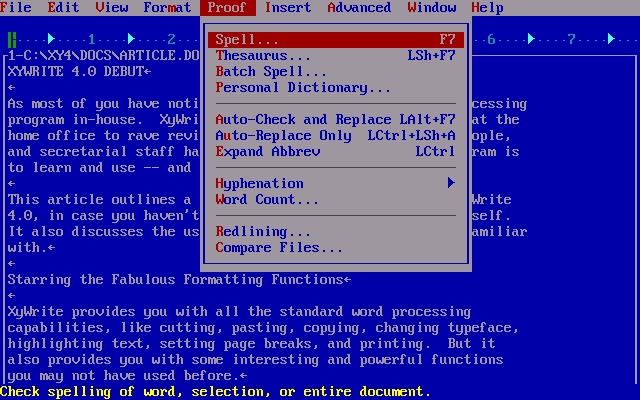
Xywrite2Can you imagine? I wrote The Essential Feature in XyWrite! Bet some of you young pups never heard of XyWrite…  It was a pure ASCII program, incredibly easy to use and, for the day, amazingly powerful. Assuming you knew DOS, that is.

Anyway, if it appears on Amazon or Smashwords, obviously no real-world publisher will pick it up. But I probably can get away with producing a few bound copies, as long as I don’t advertise them too extravagantly on the Internet.

My feeling is, though, that I don’t much want to wait two years to get print copies of this thing. It’s intended as a marketing tool, and that’s what I need it for. The Copyeditor’s Desk could comfortably increase its workflow by about 50% to 75%. That would keep me and my hired help in shoes and socks and create enough income, reliably, to cover the overhead. When you send a manuscript to an academic press, they send it out to peer reviewers, who take their sweet time reading it. Then you have to dicker back and forth about their critiques, sometimes rewriting and sometimes having to put up a fight to demonstrate that some half-baked remark is…half-baked. It takes forever.

Of course, the product is better. But…two or three years, when I can post…uhm, “publish” the thing on Amazon in 20 minutes? It’s not like this book is going to help me get tenure! 😀

Actually, one of the book’s arguments is that under some circumstances, self-publishing is a better choice than the traditional route. This would be one of those circumstances.

College: Are You Getting What You Pay For?

If you’re attending a college or university or if you have a child in college, you need to read this book.

IMG_3006As a college student, or as a student’s parent, you face endless tuition increases. Do you know what that tuition is buying — and not buying?

Some 80% of college instructors are not professors at all, but underpaid, often underqualified part-time adjuncts. Fewer and fewer American students get what they pay for when they arrive on a college campus. Meanwhile, graduate programs churn out thousands of would-be college faculty with master’s and doctoral degrees, few of whom ever land full-time jobs in education.

Quality of higher education drops as full-time faculty disappear and are replaced by part-timers with no infrastructure, low pay, no benefits, and no representation.

This book explains the short- and long-term effects of replacing professors with part-timers and chronicles one adjunct’s semester in America’s largest community college district. Available at Amazon (click on the link) or in a handsome print copy through Plain & Simple Press’s Contact Page.

If you're attending a college or university or if you have a child in college, you need to read this book.

Chalkboard image: Shutterstock. © 2016 ImageFlow

Slave Labor: Do you REALLY want that PhD?

IMG_3006Lo, what should I find at Amazon this morning but a nice review of Slave Labor! And then, while seeking something else, a confirmation of Slave Labor’s thesis in Yuval Bar-Or‘s Is a Ph.D. for Me?, verbosely but accurately subtitled  Life in the Ivory Tower: A Cautionary Guide for Aspiring Doctoral Students. 

Too many young men and women who go into PhD and MFA programs have no idea what awaits them. Every would-be graduate student should read these two books.

Bar-OrIf you understand what to expect and if you have an independent source of income, by all means get a PhD in whatever subject warms your heart. But bear in mind that a PhD is a professional degree, not a program whose purpose is to turn out a man (or woman) for all seasons.

A “professional” degree should get you into a profession, but more and more PhD programs fail to do that. As a steadily increasing proportion of American faculty is relegated to the sweat-shop, your chance of landing a full-time job that will support you and a family is remote, at best.

Do you REALLY want that Phd? Too many young men and women who go into Ph.D. and MFA programs have no idea what awaits them. Food for thought about college programs.Do I regret having pursued a doctorate? Not much. But my circumstances were exceptional:

  • I was  married to a man who was among the top 3 percent of earners in this country.
  • He was a public-intellectual sort of guy who ran in some very brainy circles, and so adding a PhD to my name made me a variety of trophy wife.
  • My real job was to support him in the community, take care of his home, raise his child, and manage his social life. So, as a practical matter I had gainful employment outside of academia.
  • And I stumbled into journalism, pretty much by serendipity. While the doctorate didn’t directly affect my performance there, behind the scenes it did help me to land the best job of my working lifetime, an editorial position at a large regional magazine.
  • Twenty years of journalism experience plus the disused doctorate got me in the door, after a divorce, to a full-time (but nontenurable!) position at a large state university. As Bar-Or suggests, academia is not the happiest place to put food on your table. But in the unlikely event that you obtain full-time work, it suffices.

Often, though, I reflect that had I started in magazine journalism after I finished the master’s degree, I would have had one hell of a lot more fun and, by using the time to gain job experience, would have gone much further up the executive stairwell.

Some doctoral degrees will give you entrée to corporate and high-level government jobs. Economics is one of them. A master’s in journalism is another (I would not pursue a PhD in that trade). The PhD in psychology has some potential, but in terms of earning a living, a master’s in nursing can help you to become a psychiatric nurse practitioner, which more reliably will return a six-figure income.

Think it through. Don’t get a doctorate in a subject just because you “love” it. Get a doctorate, if you must, solely as a career move. And be damn sure that career will be open to you when you complete the degree.

What are some guidelines that might help you think this decision through? Start with these:

  1. Never assume you’ll be able to get a job in university or community-college teaching. To the contrary: assume that at best you’ll spend several years as a grossly underpaid part-time adjunct, that you’ll be outlandishly lucky to nail a full-time position, and if you do, it probably will be in Podunk, South Dakota.
  2. Research employment avenues in government and business. Get on the phone (talk to somebody!) and request informational interviews with people who are in the kinds of jobs you think your degree might lead to. Ask how difficult it is to obtain work in that person’s field, and whether the doctorate would be an asset, a hindrance, or a neutral embellishment.
  3. Select your school with care. In academe, the quality of your degree-granting institution matters. Every advertisement for a full-time opening draws hundreds of qualified applicants: competition is beyond fierce. Especially for academic jobs, it’s crucial to take your degree at an R-1 university. If you don’t know what that is, think about some other line of work.
  4. Do not imagine that even though everyone else has a tough time getting an academic job, it won’t be that way for you. No matter how good you are, you are not special!
  5. Do not imagine that you’ll get your foot in the door as an adjunct or research associate and then in a year or two the department will be thrilled to take you on full-time.
  6. Get an exquisitely clear view of how much the program will cost. Remember to include the cost of housing, food, and commuting, as well as books, tuition, and the school’s miscellaneous rips.
  7. If you have to finance graduate school with a loan, calculate realistically how long it will take to pay it off and how much it will cost you over that period. And don’t forget to add an extra year in school, beyond what you imagine it will take to complete the degree. Most people spend a year or more after their coursework to write the dissertation.
  8. Consider pursuing the degree in another country, such as Canada, where tuition may be lower than US schools charge these days.

PhD image: Shutterstock. © 2016 Lemon Tree Images

Call for Stories! Cat stories

shutterstock_381223837 catHave you ever had a problem with a neighbor’s cats? How was it resolved? Or was it? For a book on cats, we’re looking for stories about issues related to cats allowed to run free.

Please tell us yours. What was the problem? Did any property or personal injury (to you, to your kids, or to your pets) result? Did any legal action ensue? Were you able to resolve the problem with steps that were within the law? Please navigate the Plain & Simple website and share your story on our “Contact” page.

Image: Shutterstock. © 2016 Polina Nogovitsyna

Snowed In? Warm up with an easy pot roast

Classic pot roast made easy with this simple crockpot recipe. It can simmer all day while you're at work.

We’re told our friends on the East Coast are getting snowed on again. If you’re cold and feeling harried, try this easy, delicious crockpot roast. It can simmer all day while you’re at work, or you can speed it along by way of nourishing the kids on a snow day. Serve it over rice and it shouldn’t put on too many pounds:

La Maya’s Port-laced Crockpot Roast

Prep time: 15 minutes
Cooking time: low 8 to 10 hours, or high 4 to 5 hours
Makes 8 to 10 servings

A classic pot roast made easy

A classic pot roast made easy

You Need:

  • 2½- to 3-pound beef chuck roast
  • 1/2 cup chopped onion (1 medium)
  • 1/2 cup port wine
  • 8-ounce box or can of tomato sauce, preferably a low-salt brand such as Pomí
  • 3 Tbsp quick-cooking tapioca
  • 1 Tbsp Worcestershire sauce
  • 1 tsp dried thyme, crushed (or use up to a Tbsp fresh thyme)
  • 1 tsp dried oregano or marjoram (or up to a Tbsp fresh herbs)
  • 2 cloves garlic, minced
The Douro Valley — Home of port wine.

The Douro Valley — Home of port wine.

Trim any excess fat from meat. If needed, cut the roast to fit your slow cooker. Place the meat in the crockpot.

Make a cooking stock by combining the cut-up onion, port, tomato sauce, tapioca, Worcestershire sauce, herbs, and garlic. Pour this combination over the meat.

Cover and cook on the cooker’s low-heat setting for 8 to 10 hours, or on high-heat setting for 4 to 5 hours.

Transfer the cooked meat to a serving dish. Skim fat from gravy. Pass gravy with the roast and serve with pasta, potatoes, or rice.

Enjoy! And stay warm.

This is one of over a hundred delicious and good-for-you recipes in 30 Pounds/ 4 Months, your guide to losing weight while eating like the Queen of Sheba. Find the Kindle version at Amazon or buy a print copy direct from Plain & Simple Press.

Images:
Classic pot roast made easy: Shutterstock. © 2016 bolsher

Pot roast: Mark Miller (Own work) [CC BY-SA 4.0 (http://creativecommons.org/licenses/by-sa/4.0)], via Wikimedia Commons
Douro Valley: Bruno Rodrigues, CC BY-SA 3.0, https://commons.wikimedia.org/w/index.php?curid=3383426